

TEST
Respirable and Inhalable Dust
Workplace Health Surveillance & Lung Function Testing
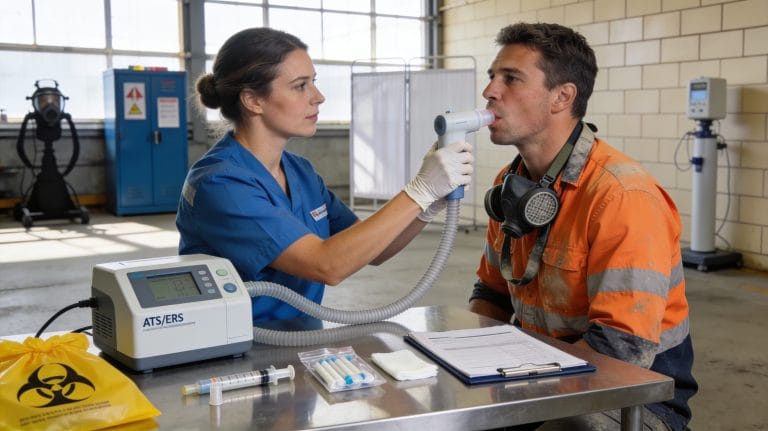
Workplace Health Surveillance & Lung Function Testing
Occupational Hygiene & OHS Solutions (OHOS) Pty Ltd delivers specialist workplace health surveillance for respirable and inhalable dust, combining onsite lung function testing with practical risk‑management advice across New South Wales and Victoria. Our services are designed for employers who need compliant, defensible, and meaningful respiratory health monitoring programs for high‑dust and high‑hazard industries.
This service is delivered under the same expert team and integrated business model as Audiometrics & Medical Personnel (audiomet.com.au), ensuring continuity of clinical and occupational hygiene standards, with full alignment on WHS, SafeWork NSW, and WorkSafe Victoria respiratory health‑surveillance expectations.
Why Focus on Respirable and Inhalable Dust?
Respirable and inhalable dust exposures are at the centre of many serious occupational lung diseases, including those driven by respirable crystalline silica (RCS), welding fumes, diesel particulate matter, and other airborne contaminants. Under Australian WHS frameworks, employers must manage these risks through exposure measurement, control, and appropriate health surveillance, including spirometry where workers are exposed to hazardous dusts. [worksafe.vic:202]
At OHOS, we help you move beyond simple “tick‑a‑box” testing by integrating:
Occupational hygiene dust monitoring (respirable and inhalable fractions)
Baseline and periodic spirometry for respiratory health
Exposure‑risk documentation and management recommendations
This approach directly supports your WHS duty to prevent chronic lung conditions such as silicosis, occupational asthma, and other respiratory impairment linked to long‑term dust exposure. [worksafe.vic:201]
How OHOS Can Help with Respirable and Inhalable Dust
We provide a coordinated, end‑to‑end service that sits at the intersection of occupational hygiene, clinical lung‑function testing, and compliance‑driven risk management. Whether you operate in NSW, Victoria, or across both states, our model supports:
Workplace health surveillance programs for workers exposed to respirable crystalline silica, welding fumes, diesel particulate, and other hazardous dusts.
Onsite lung function testing delivered at your site, with minimal disruption to shift patterns and site operations.
Long‑term respiratory health tracking using FEV1, FVC, and spirometry trend analysis, aligned with ATS/ERS standards and Australian WHS guidance.
For Employers and Safety Managers
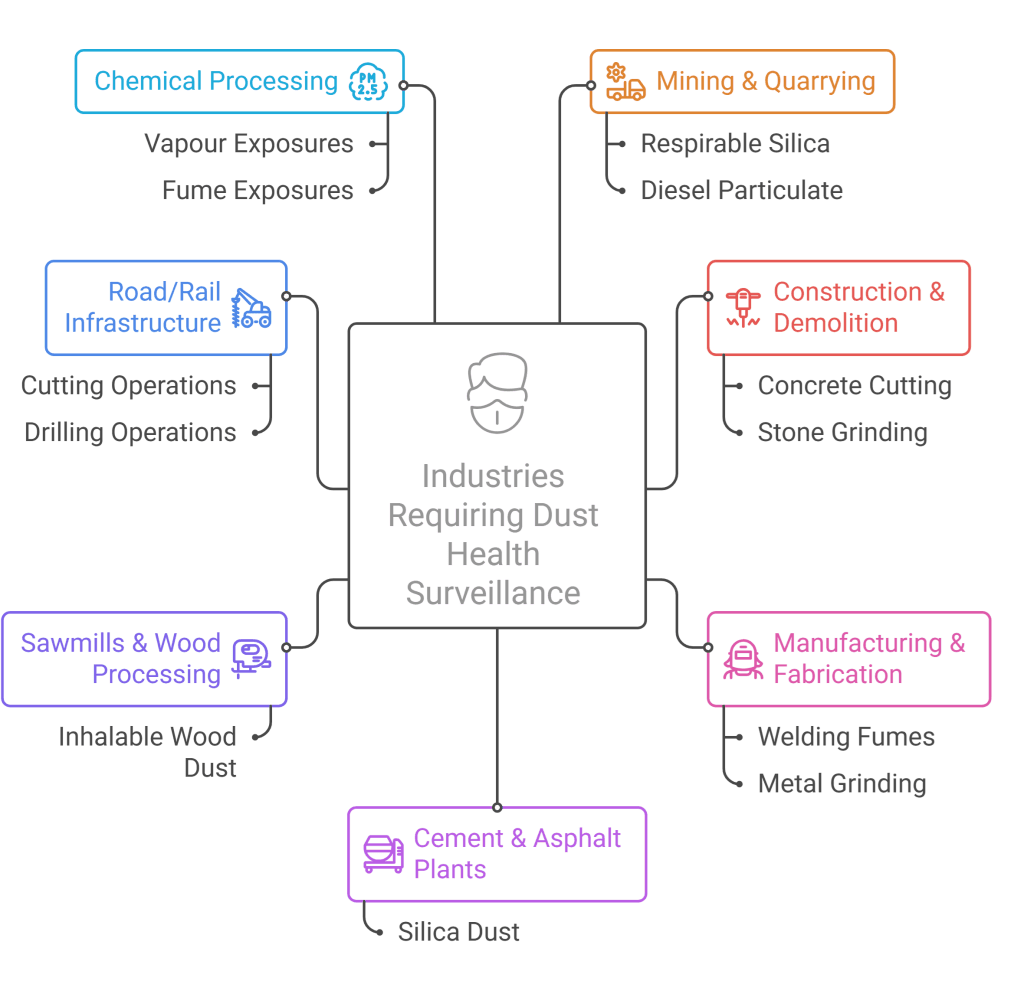
For businesses managing foundries, mining and quarrying, tunnelling, concrete cutting, demolition, heavy fabrication, and chemical or asphalt plants, OHOS can:
Design and implement a statutory‑compliant respiratory health‑monitoring program.
Integrate spirometry within your existing occupational hygiene assessment and respiratory‑protective equipment (RPE) fit‑testing processes.
Provide clear, auditable documentation that meets SafeWork NSW and WorkSafe Victoria expectations for health monitoring and exposure‑risk records. [safework.nsw:196][worksafe.vic:186]
For Workers Exposed to High Dust
For workers in construction, manufacturing, warehousing, and industrial maintenance roles, our services support:
Baseline lung‑function testing prior to high‑dust exposure.
Periodic spirometry surveillance to detect early signs of respiratory impairment.
Confidential feedback and referral pathways if results indicate reduced lung capacity or other concerns.
What’s Included in Our Assessment
Our respirable and inhalable dust service is not just a one‑off spirometry test; it is a structured assessment that bridges exposure measurement and clinical lung‑function outcomes.
Core Components
Pre‑assessment consultation
We review your site details, high‑risk tasks, and existing WHS controls to focus on the correct worker groups and exposure scenarios.Onsite lung function testing (spirometry)
Certified practitioners perform ATS/ERS‑compliant spirometry using calibrated equipment, including FEV1 and FVC measurements. This supports:Workplace spirometry testing
Occupational spirometry services
Corporate lung function assessment
Workforce respiratory health testing
Respirable and inhalable dust exposure context
Where required, our hygienists can integrate spirometry with dust‑monitoring campaigns (silica, welding fumes, diesel particulate, VOCs, etc.) so that lung‑function results are interpreted against actual exposure levels.Reporting and action planning
You receive a clear report that includes:Summary of lung‑function results
Baseline vs periodic trend analysis (where applicable)
Flagging of any abnormal patterns that may indicate early respiratory impairment
Practical recommendations for workplace exposure‑control, PPE, and medical review
Assessment Process: From Planning to Compliance
Our process is designed to fit smoothly into your safety and HR systems, with minimal operational disruption.
Stage 1: Planning and Scoping
We work with your OHS, HR, and site teams to identify:
Task groups with significant respirable dust, silica, welding fumes, or chemical‑vapour exposure.
The appropriate baseline and periodic testing frequency (e.g., initial, then annual or biennial, depending on exposure level and risk).
Whether testing will be offered as part of pre‑employment spirometry, return‑to‑work, site‑specific medical clearance, or enterprise‑wide respiratory screening.
Stage 2: Onsite Testing Delivery
At your site, our team sets up a quiet, private area for spirometry and manages the process efficiently:
Onsite lung function testing using calibrated spirometers.
Staff identification and record‑keeping that aligns with your privacy and WHS requirements.
Flexible scheduling to accommodate shift work, including night shifts and weekend operations.
Stage 3: Reporting, Interpretation, and Follow‑Up
After testing, we:
Interpret results in line with ATS/ERS technical standards and occupational‑health guidelines.
Provide a workplace pulmonary function report that can be linked to your respirable dust exposure records and occupational hygiene assessments.
Flag any individuals who may require fit‑to‑work lung assessment, RPE review, or medical referral, while maintaining confidentiality.
Stage 4: Compliance and Ongoing Support
We support your ongoing compliance by:
Advising on periodic spirometry surveillance intervals.
Helping you maintain respiratory health record compliance for audits and regulator inspections.
Updating your program as new WHS or exposure‑standard guidance is published.
Respirable and Inhalable Dust: Key Service Outcomes
By choosing OHOS for your respirable and inhalable dust service, you gain:
A compliant spirometry service provider that understands NSW and Victorian WHS respiratory‑health‑surveillance requirements.
Meaningful data (not just forms) that links dust exposure to lung‑function outcomes and supports real risk‑reduction decisions.
Flexible, mobile spirometry that integrates with your existing occupational hygiene and health‑check programs.
Industries We Serve: Respirable and Inhalable Dust Health Surveillance
Service Comparison Table
| Feature | Standard Spirometry | OHOS Respirable Dust Program |
|---|---|---|
| Location | Clinic-based | Onsite service |
| Frequency | One-off | Baseline + periodic surveillance |
| Reporting | Basic results | WHS statutory compliant analysis |
| Integration | Standalone | Integrated with dust monitoring |
| Documentation | Minimal | Full regulatory compliance records |
Frequently Asked Questions (FAQs)
1. What is the difference between respirable and inhalable dust in health monitoring?
Respirable dust is the fraction small enough to reach the deep lung, where it can cause conditions like silicosis. Inhalable dust includes larger particles that mainly affect the upper airways. Our health surveillance program measures both to ensure a comprehensive risk profile and support appropriate control measures. [worksafe.vic:186]
2. When is spirometry required for workers exposed to dust?
For workers exposed to hazardous dusts such as respirable crystalline silica, welding fumes, or diesel particulate, WHS guidance recommends baseline testing before significant exposure begins, followed by periodic surveillance (often annually or more frequently for high‑risk tasks). [worksafe.vic:202]
3. Can you conduct testing across multiple sites or states?
Yes. Our model supports on‑site lung function testing and respiratory‑health surveillance across NSW, Victoria, and other Australian states, allowing you to standardise your program and maintain consistent records.
4. Do you work with contractors and labour‑hire arrangements?
Yes. We frequently assist employers and labour‑hire companies with contractor lung testing requirements, site‑compliance lung assessments, and enterprise respiratory‑risk management.
5. How long does an onsite spirometry assessment take per worker?
Most individual spirometry sessions take approximately 10–15 minutes, depending on the number of tests and any additional questions. We plan testing blocks to minimise disruption and support high‑throughput during shutdowns or major projects.
6. What happens if abnormal lung‑function results are detected?
We provide confidential feedback to the relevant medical practitioner or your nominated clinician, who determines any required follow‑up. At the same time, our team can advise on reviewing exposure controls, RPE, and task design to reduce risk. [safework.nsw:196][worksafe.vic:202]
7. Are results stored securely and kept confidential?
Yes. All lung‑function data and health‑monitoring records are handled in line with privacy legislation and WHS requirements. Access is restricted to authorised medical and occupational‑health personnel, and employers receive aggregated, non‑identifiable reports where appropriate.
8. Can this service be combined with other health checks?
Absolutely. We regularly integrate spirometry and respiratory health screening with broader workplace health checks, fit testing for respiratory protection, and occupational hygiene assessments, giving you a single‑point, coordinated health‑monitoring program.
9. How do you ensure your spirometry meets technical standards?
We use calibrated equipment and follow ATS/ERS technical standards for spirometry, including quality‑assurance and calibration checks. Our practitioners are trained in occupational lung‑function testing and interpreting results in the context of workplace exposures.
10. What documentation do you provide to demonstrate compliance?
You receive:
Individual spirometry reports (where appropriate, via your medical practitioner).
Aggregated summary reports for site or enterprise review.
Documentation that supports your respiratory health record compliance and health‑monitoring program for SafeWork NSW and WorkSafe Victoria audits.
Start Protecting Your Workforce Respiratory Health Today
Take confident steps toward comprehensive dust exposure management and lung function protection. Contact Occupational Hygiene & OHS Solutions (OHOS) Pty Ltd for tailored respirable and inhalable dust surveillance, spirometry testing, compliance support, and specialised reporting—servicing NSW and Victoria with solutions designed to minimise respiratory risk, achieve WHS compliance, and safeguard your workforce health.