

TEST
Post Fire Remediation Assessment
Post Fire Remediation Assessment
Post fire remediation assessment is the process of evaluating contamination after a fire event. It focuses on identifying harmful residues in the air, on surfaces, and within the building environment.
Rather than relying on visual inspection alone, this assessment looks deeper into smoke and soot spread, chemical residues, and air quality impacts. The objective is to confirm whether fire damage clean up has been effective and whether the site is safe for workers to return.
At Occupational Hygiene & OHS Solutions (OHOS) Pty Ltd, assessments are carried out using practical, site-based methods aligned with workplace safety requirements.
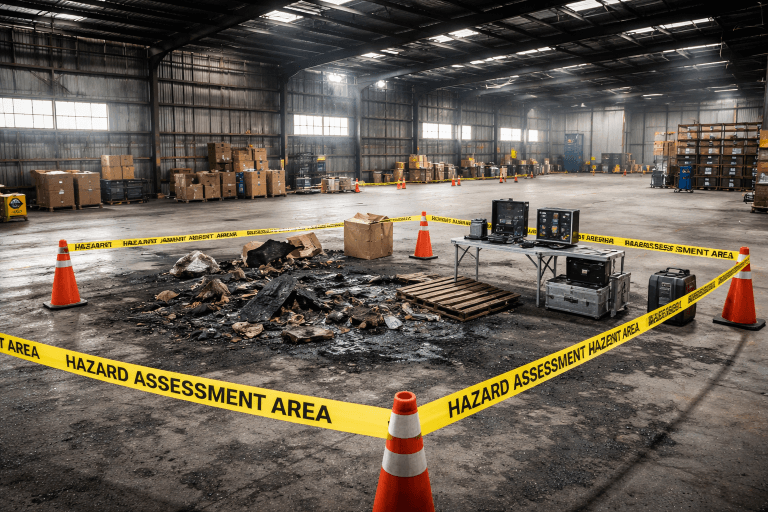
Why Fire Remediation Assessment Matters
Fire damage is often underestimated because visible cleanup does not always remove invisible contaminants. Even after a fire restoration company completes cleaning, hazardous particles and gases may remain within the workplace.
A professional assessment helps verify whether remediation has been successful, protects worker health, supports compliance with workplace safety obligations, and reduces the risk of reopening a contaminated site. It also provides documented evidence that can support insurance and regulatory requirements.
Health Risks After Fire Damage
Fire incidents release a complex mix of contaminants depending on the materials involved. These may include soot, fine particulate matter, volatile organic compounds, and chemical by-products from burnt materials.
If these contaminants are not properly assessed and managed, they can remain in the environment and pose ongoing health risks. Workers may experience respiratory irritation, discomfort, or longer-term health concerns, particularly in enclosed or poorly ventilated spaces.
Do You Need a Post Fire Assessment
A post fire assessment should be considered whenever there is a possibility that contamination has spread beyond the immediate fire area. This is especially relevant when fires involve stored goods, plastics, fuels, or chemicals, or when smoke has travelled through multiple zones.
It is also important when workers report odours or irritation, when the site needs to reopen quickly, or when insurance providers require verification. In many cases, even small fire events can lead to widespread contamination that is not immediately visible.
Key Post-Fire Risks Often Missed
- Residual contamination inside ducting and ventilation systems
- Re-settling of soot particles after initial clean up
- Chemical absorption into porous materials like timber and insulation
- Cross-contamination between affected and unaffected zones
- Hidden residues on high surfaces, beams, and ceilings
- Ongoing off-gassing from burnt plastics and synthetic materials
What Businesses Gain from Proper Assessment
- Clear understanding of contamination spread and severity
- Confidence in reopening decisions without health risks
- Reduced liability related to worker exposure
- Strong documentation for insurance and compliance
- Targeted remediation instead of repeated general cleaning
- Faster recovery of operations with verified safety
Situations Where Immediate Testing Is Recommended
- Fire involving chemicals, fuels, or plastics
- Smoke spread across multiple rooms or buildings
- Enclosed environments with limited ventilation
- Workplaces with sensitive equipment or stored goods
- Reports of irritation, odour, or discomfort from staff
- Sites requiring rapid reopening under compliance pressure
How Our Assessment Works
Our approach is structured to deliver accurate results while minimising disruption to your operations. At Occupational Hygiene & OHS Solutions (OHOS) Pty Ltd, we begin with a detailed onsite inspection to understand the extent of fire impact and identify areas of concern. This is followed by targeted sampling, which may include air monitoring, surface testing, and residue collection to detect hidden contamination.
All samples are analysed using validated laboratory methods to ensure reliable outcomes. Based on these results, we provide a clear and practical report outlining contamination levels, risk interpretation, compliance considerations, and recommended next steps for safe re-occupancy.
Industries We Work With
Post-fire contamination affects each industry differently depending on materials, processes, and building layout. In many cases, the visible damage is only a small part of the problem, while residual contamination continues to impact operations, safety, and compliance.
Manufacturing Facilities
Manufacturing environments often contain machinery, oils, plastics, chemicals, and raw materials that can produce complex combustion by-products during a fire. Even after fire damage clean up, soot and chemical residues can settle on equipment, production lines, and stored materials.
This creates challenges such as contamination of finished goods, corrosion of machinery, and ongoing airborne exposure risks. Without proper assessment, restarting operations may expose workers to hazardous residues or lead to further operational losses.
Warehouses and Logistics Centres
Warehouses typically store large volumes of mixed goods, including packaging materials, textiles, plastics, and chemicals. When a fire occurs, smoke can spread rapidly across wide open spaces and through racking systems, contaminating areas far from the source.
A common issue is that stock, pallets, and storage areas may appear unaffected but still carry fine soot or chemical residues. This creates risks around product integrity, worker exposure, and insurance claims, making post-fire remediation assessment critical before resuming operations.
Construction and Industrial Sites
Fire incidents on construction or industrial sites can involve building materials such as treated timber, insulation, coatings, and composites. These materials can release hazardous particulates and gases when burnt, which may settle into dust or remain airborne.
The challenge in these environments is that contamination can mix with existing site dust, making it difficult to identify exposure risks without proper testing. Workers involved in clean-up or ongoing construction activities may unknowingly be exposed if assessment is not carried out.
Commercial and Retail Spaces
In commercial buildings and retail environments, fire damage often extends beyond the immediate area due to shared air systems and enclosed layouts. Smoke and residues can travel through HVAC systems, affecting offices, storage rooms, and customer-facing spaces.
This can lead to persistent odours, surface contamination, and indoor air quality concerns that impact both employees and customers. Businesses may also face pressure to reopen quickly, making it essential to confirm that the environment is safe and compliant.
Mining and Processing Facilities
Mining and processing sites often involve heavy equipment, fuels, and high-temperature processes, which can intensify the type and spread of fire-related contaminants. Fires in these environments may generate complex mixtures of particulates and chemical residues that settle across large operational areas.
These sites also face additional challenges due to remote locations and continuous operations. Without proper post-fire assessment, there is a risk of ongoing worker exposure, equipment contamination, and non-compliance with safety standards.
Speak With an Occupational Hygiene Consultant
Post-fire contamination is not always visible and can vary depending on materials burned and site conditions. Even after fire damage clean up and smoke remediation, harmful residues may remain and require professional assessment.
For residential premises post fire remediation assessment support, contact Occupational Hygiene & OHS Solutions (OHOS) Pty Ltd to discuss your site requirements.
Alternatively, complete the enquiry form below and our team will assist you with the next steps.