

TEST
Diesel Particulate Matter (DPM) Assessment
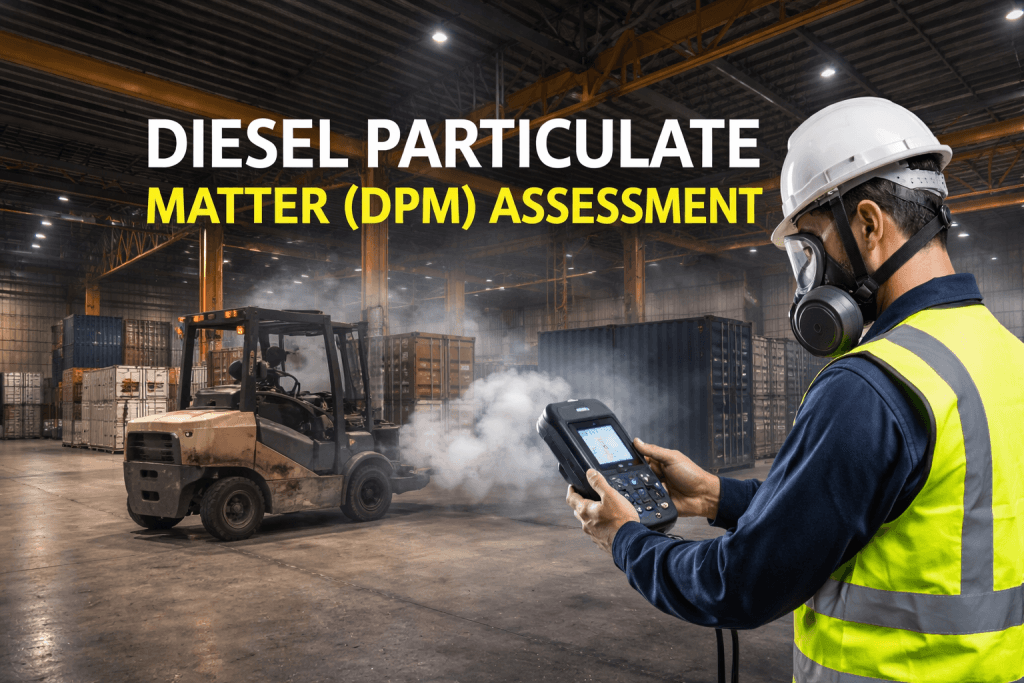
Diesel Particulate Matter (DPM)
Occupational Hygiene & OHS Solutions Pty Ltd (OHOS Solutions) provides specialist diesel particulate matter (DPM) assessment, monitoring and testing services for workplaces across New South Wales and Victoria. Our team works with mining, construction, transport, logistics and industrial operators to quantify diesel exhaust exposure, evaluate airborne diesel particulate risks and implement controls that align with current guidance and emerging exposure standards.
What is diesel particulate matter and DPM exposure
Diesel particulate matter (often shortened to DPM) is the fine, soot‑like component of diesel engine exhaust that includes ultra‑fine carbon particles, ash, and adsorbed organic compounds such as polycyclic aromatic hydrocarbons. These particles can be inhaled deep into the respiratory system and are classified as carcinogenic to humans, meaning they increase the risk of lung and other cancers.
Diesel exhaust exposure is a significant workplace health issue in enclosed or semi‑enclosed environments, including underground mines, tunnels, construction sites, workshops, warehouses and transport depots. As guidance tightens, is diesel particulate dangerous is no longer a theoretical question for WHS duty holders; it is a central risk that must be systematically assessed and controlled.
Diesel particulate matter assessment and why it is essential
A diesel particulate matter assessment is the first step in understanding where and how workers are exposed to diesel exhaust. Our diesel particulate matter assessment services are designed to identify high‑risk tasks, locations and equipment, and to determine whether current controls are sufficient to keep diesel particulate exposure ALARP (as low as reasonably practicable).
Key elements of our diesel particulate matter assessment include:
site‑walk audits and consultation with operators, maintenance crews and safety teams;
development of a risk‑based sampling strategy for personal and area monitoring;
selection of appropriate sampling methods (NIOSH 5040‑equivalent) and exposure‑periods aligned with real‑world shifts.
This workplace diesel particulate assessment supports compliance with WHS diesel particulate assessment requirements and helps you prepare for the anticipated national diesel particulate matter workplace exposure standard.
Diesel particulate matter assessment and why it is essential
A diesel particulate matter assessment is the first step in understanding where and how workers are exposed to diesel exhaust. Our diesel particulate matter assessment services are designed to identify high‑risk tasks, locations and equipment, and to determine whether current controls are sufficient to keep diesel particulate exposure ALARP (as low as reasonably practicable).
Key elements of our diesel particulate matter assessment include:
site‑walk audits and consultation with operators, maintenance crews and safety teams;
development of a risk‑based sampling strategy for personal and area monitoring;
selection of appropriate sampling methods (NIOSH 5040‑equivalent) and exposure‑periods aligned with real‑world shifts.
This workplace diesel particulate assessment supports compliance with WHS diesel particulate assessment requirements and helps you prepare for the anticipated national diesel particulate matter workplace exposure standard.
Diesel particulate matter monitoring and workplace exposure monitoring DPM
Diesel particulate matter monitoring is an ongoing process that confirms whether engineering and administrative controls are effective over time. Our DPM monitoring services are tailored to NSW and Victorian workplaces, including underground, surface, industrial and transport environments.
Workplace DPM monitoring typically includes:
personal exposure monitoring for high‑risk roles (underground diesel particulate monitoring, equipment operators, workshop mechanics);
static or area monitoring to assess background air quality and ventilation performance;
comparison of current and historical data to demonstrate continuous improvement.
Our workplace exposure monitoring DPM programs are designed to support occupational exposure assessment diesel programs and align with Australian Institute of Occupational Hygienists (AIOH) guidance on exposure levels for elemental carbon.
Diesel particulate matter testing and data interpretation
Diesel particulate matter testing involves the collection of air samples, laboratory analysis for elemental or respirable carbon, and interpretation of results against relevant exposure guidance. Our DPM testing services are laboratory‑backed and focus on delivering clear, actionable insights rather than raw numbers.
Onsite DPM testing can:
show whether current diesel particulate exposure is within ALARP thresholds;
highlight which tasks or machines contribute most to airborne diesel particulate exposure;
support decisions on filter upgrades, ventilation improvements and alternative‑fuel options.
As diesel particulate testing Australia‑wide adopts more rigorous methods, our services are aligned with recognised analytical techniques and national exposure‑standard changes.
Diesel exhaust exposure, health risks and controls
Diesel exhaust exposure is linked with a range of adverse health effects, including respiratory irritation, chronic lung disease and an increased risk of lung and bladder cancer. Because diesel engine exhaust is classified as a Group 1 carcinogen, regulators emphasise the need for proactive control of diesel particulate exposure.
Our approach to diesel exhaust health risks includes:
identifying tasks where diesel exhaust particulate exposure is highest;
recommending engineering controls (ventilation, exhaust extraction, engine retrofits);
supporting administrative controls (job rotation, reduced time in high‑exposure zones).
Compliance, diesel particulate exposure limits and workplace safety
Diesel particulate exposure limits are evolving across Australia. NSW uses an 8‑hour time‑weighted average exposure standard of 0.1 mg/m³ of submicron elemental carbon for diesel particulate matter in mines and petroleum sites, while SafeWork Australia has proposed a future workplace exposure limit of 0.01 mg/m³ respirable elemental carbon from 1 December 2026.
Our workplace compliance DPM services help you:
benchmark current diesel particulate matter levels against current and future exposure standards;
document exposure reduction strategies suitable for SafeWork Australia, WorkSafe Victoria and other WHS regulators;
align your program with ISO 45001‑aligned risk‑management frameworks.
Industry‑specific DPM risks and services
Different industries face different diesel particulate profiles. Our industrial diesel particulate assessment and monitoring services are tailored to:
Mining diesel particulates: mining DPM assessment and underground diesel particulate monitoring for longwall operations, continuous miners and haulage equipment.
Construction diesel particulates: construction diesel particulate monitoring and tunnel diesel particulate assessment for tunnelling and heavy civil projects.
Transport & logistics diesel exposure: transport diesel particulate exposure and warehouse diesel exhaust exposure assessments for depots, loading bays and maintenance workshops.
Onsite and mobile DPM services across Australia
Our workplace DPM testing services are delivered as onsite and mobile programs, allowing us to operate across metropolitan, regional and remote locations in NSW and Victoria. This ensures testing reflects real‑world operating conditions and shift patterns, with minimal disruption to operations.
Benefits of our onsite and mobile DPM services include:
flexible scheduling to match day, night and swing shifts;
rapid deployment across multiple sites under a single program;
prompt reporting and clear recommendations suitable for WHS committees and senior management.
Diesel particulate assessment and monitoring – comparison of approaches
The table below summarises common approaches to diesel particulate matter assessment and monitoring.
| Control Layer | Example Measures | Effectiveness | Application Examples |
|---|---|---|---|
| Engineering Controls | Improved ventilation, exhaust extraction, diesel particulate filters (DPFs), low‑emission engines | High | Underground mines, tunnels, workshops, enclosed depots |
| Administrative Controls | Reduced idling, limiting number of vehicles in confined spaces, job rotation away from high‑exposure zones | Moderate | Construction sites, loading bays, transport yards, maintenance areas |
| Monitoring & Assessment | Diesel particulate matter assessment, workplace DPM monitoring, diesel particulate testing | Moderate/Information‑based | Mining, industrial facilities, transport hubs, construction projects |
Your partner for diesel particulate matter programs in Australia
Occupational Hygiene & OHS Solutions Pty Ltd is a certified occupational hygiene and workplace health consulting firm, led by a Certified Occupational Hygienist with over 20 years of experience across mining, construction, transport and industrial sectors. Our services are aligned with SafeWork Australia guidance, AIOH recommendations and best‑practice occupational hygiene methods.
When you engage us for a diesel particulate matter assessment, DPM monitoring or DPM testing, you receive:
technically rigorous, regulator‑aligned assessment and sampling;
clear, non‑technical summaries and control recommendations;
comprehensive documentation suitable for WHS regulators and internal governance.
Ready to manage your diesel particulate exposure?
As exposure standards tighten and the question of when is DPM monitoring required becomes more urgent, proactive assessment and monitoring are essential.
Book a diesel particulate assessment for your NSW or Victorian site to understand your current exposure profile.
Request a DPM monitoring quote to build an ongoing workplace DPM monitoring program that keeps your team’s exposure ALARP.
Contact our national diesel particulate assessment company to discuss diesel particulate testing services, workplace DPM monitoring, and compliance‑ready reporting.
Frequently Asked Questions (FAQs)
- What is the difference between diesel particulate matter and general diesel exhaust exposure?
Diesel particulate matter (DPM) refers specifically to the fine, soot‑like carbon particles in diesel exhaust, whereas “diesel exhaust exposure” includes the broader mix of gases (such as nitrogen oxides and carbon monoxide) plus these particulates. Occupational Hygiene & OHS Solutions Pty Ltd focuses on characterising and controlling DPM because it is the component most strongly linked with long‑term lung health risks. - How often should a diesel particulate matter assessment be repeated on site?
A diesel particulate matter assessment should be reviewed whenever there is a significant change in equipment, ventilation, work processes or shift patterns. For high‑risk workplaces such as underground mines and busy transport depots, many duty holders choose to repeat workplace diesel particulate assessment every 12–24 months, or more frequently if control measures are being upgraded. - Can DPM monitoring be done without disrupting normal operations?
Yes, our mobile DPM monitoring services are designed to integrate into existing shifts and workflows. Monitors are typically small and unobtrusive, and sampling can be scheduled around key tasks so that equipment and staffing routines are not interrupted. Our goal is to capture realistic exposure data while minimising impact on daily operations. - Do diesel particulate tests need to be carried out by a certified occupational hygienist?
While there is no mandatory requirement that sampling must be supervised only by a certified occupational hygienist, having a Certified Occupational Hygienist oversee the program adds technical credibility and ensures that sampling methods, lab selection and interpretation align with best‑practice standards. At Occupational Hygiene & OHS Solutions Pty Ltd, all DPM testing and monitoring programs are led by accredited hygienists. - How quickly are DPM test results and reports available?
Most diesel particulate matter testing results are available within 5–10 working days of laboratory analysis, depending on the number of samples and the complexity of the project. We then prepare a concise report outlining key findings, exposure levels relative to current guidance, and practical control recommendations. This turnaround supports timely decision‑making for site managers and WHS committees. - What types of equipment benefit most from diesel particulate matter monitoring?
Operations that typically benefit most from diesel particulate monitoring include underground mining equipment (continuous miners, shuttle cars, haul trucks), tunnelling machinery, construction plant operating in enclosed areas (excavators, loaders, drills), and fleets working in enclosed depots or workshops. These environments are where diesel exhaust can accumulate and create the highest personal exposure risk. - Can diesel particulate matter exposure be reduced by using alternative fuels or engine upgrades?
Yes, switching to cleaner‑burning diesel blends, using selective catalytic reduction (SCR) systems, or retrofitting diesel particulate filters (DPFs) can significantly reduce diesel exhaust particulate emissions. In many cases, these changes form part of a broader control strategy that also includes improved ventilation and work‑practice changes, which we help to evaluate and monitor. - Is diesel particulate matter exposure a concern only in underground or enclosed spaces?
No, diesel particulate exposure is a concern wherever diesel‑powered equipment operates in close proximity to people, even in open areas. Loading bays, maintenance yards, outdoor construction sites, and busy transport hubs can all experience elevated background DPM levels, especially when multiple vehicles are operating simultaneously. Our industrial diesel particulate assessments consider both enclosed and open‑air environments. - How does personal exposure monitoring diesel differ from area monitoring?
Personal exposure monitoring diesel measures the concentration of DPM in an individual’s breathing zone over a full shift, giving a more accurate picture of that worker’s actual risk. Area monitoring, by contrast, measures background DPM levels in specific locations (for example, an underground roadway or workshop bay) and helps evaluate ventilation and general air quality. Both types of data are often used together in a workplace DPM monitoring program. - How can my business choose the right diesel particulate assessment company?
When selecting a diesel particulate assessment company, look for providers that employ Certified Occupational Hygienists, follow nationally recognised sampling and analytical methods, and can demonstrate experience in your specific industry (e.g., mining, transport or construction). At Occupational Hygiene & OHS Solutions Pty Ltd, our consultants are Registered Occupational Hygienists with more than 20 years of experience, and we provide clear, practical reporting rather than generic generic templates.
Speak with workplace noise and occupational hygiene specialists
Take the guesswork out of workplace noise compliance with expert support from Occupational Hygiene & OHS Solutions (OHOS) Pty Ltd. Our experienced occupational hygienists deliver thorough workplace noise assessments, practical risk management advice, and clear reporting aligned with regulatory requirements.
Whether you need to assess employee noise exposure, manage ongoing risks, or meet WHS obligations, our team is ready to help. Contact us today to discuss your requirements, request a quote, or book your workplace noise assessment with confidence.